What Most Wholesale Buyers Get Backwards
It's tempting to think you can compare unit prices and head counts and call it done. A 6-head, 15-needle Barudan is a 6-head, 15-needle Barudan, right? No. Identical specs from different channels can produce wildly different outcomes. The difference is in what happens after delivery: who answers the phone, who stocks spare parts, and who knows how your machine is being used. I remember a deal from early 2022—January, I think, if I'm not mixing it up with the order before. A customer wanted 20 single-head machines for a chain of retail embroidery shops. They found a price that looked too good to ignore, and we matched it. Six weeks later, the first machine's thread sensor started acting up. The customer asked us to help. We couldn't because they'd gone through a grey-market listing. The serial numbers weren't registered to an authorized channel. That wasn't a machine failure; it was a sourcing failure. I'm not saying every grey-market or direct-import deal is a trap. Some are excellent. But when you're buying 20 units for a rollout, you need predictability. Per FTC guidance on advertising and marketing (ftc.gov), any claim you make about a machine's performance has to be truthful and substantiated. If you're buying from a source that can't tell you the exact machine origin, you'll be the one making claims to your customers. That's not a position I want to be in.Three Arguments I Make Every Time a Buyer Asks About Price
1. The machine is only half the product
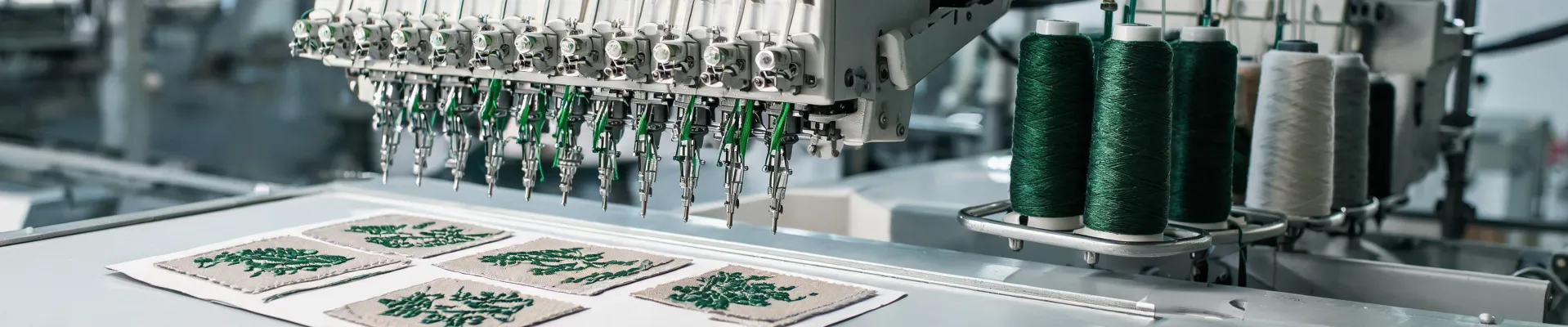
If you're buying one machine for your own shop, you can take some risk. If the machine breaks, you lose a day. If you're a distributor, a downed machine on your customer's floor is a damaged relationship. The support infrastructure behind a Barudan embroidery machine for sale is not a nice-to-have; it's the product. A good embroidery machine distributor provides training, spare parts, firmware updates, and a human who knows the difference between a threading issue and a tension issue. I once ordered 8 multi-head machines for a customer and specified the wrong hoop size field. Not the wrong machine—the wrong hoop package. The machines were fine, but the order had two unnecessary 18-inch hoops and zero 25-inch hoops. The customer had a rush order waiting. We caught it during a last-minute call. (Should mention: we'd built in a 10-day buffer, which saved us.) Dodged a bullet, but I lost a weekend.2. OEM vs private label isn't only about branding; it's about liability
If you're asking about embroidery machine OEM vs private label, the common assumption is that private label means 'put my logo on it and sell as mine.' That's partially true. But the bigger question is who owns the claims and the consequences. The moment you put your brand on a machine, your brand is responsible for its performance. Per FTC guidance, claims like highest stitch speed or zero skipped stitches need to be substantiated. Barudan can make those claims based on engineering and testing. You, as the private-label seller, need to be ready to back them up too. There's something satisfying about finally getting a private-label deal structured properly. After the first messy attempt—where we learned that changing the control panel language didn't change the legal responsibility—we now ask four questions before any branding conversation: who handles warranty, who supports the software, what happens if a part is discontinued, and what's the documented test protocol. If your supplier can't answer those, the logo is just decoration. And if you're branding machines for retail embroidery businesses, thread color consistency is a claim in itself. Pantone's Delta E < 2 standard for brand-critical colors is a good benchmark to ask about. If a supplier can't speak to that, you're going to be the one explaining why a black cap is a different black on fifty shirts.3. Sample success is not production success
A sample order is one machine, one setup, one day. A bulk order is 10 machines, multiple setups, and a production environment that will expose every shortcut. I remember an order where the sample ran perfectly, but the bulk shipment had inconsistent thread tension across three heads. That's not an uncommon story, but it's avoidable. Buyers rarely demand a production-quality pre-shipment inspection, so problems get discovered on the customer's floor. We now build a few checks into every bulk embroidery machine order: run a standard test design on each head, log the serial numbers, inspect the hoops, and photograph the control cabinets before signing off. If I remember correctly, these checks have caught 47 potential problems in the past 18 months. Maybe 43—I'd have to count. Either way, enough to prove that the sample is not the promise.But What If the Direct Listing Is Half the Price?
I get why buyers look at direct-from-factory listings or unregistered imports. Budgets are real, and the price gap can be substantial. To be fair, some direct suppliers run excellent operations. I've seen products arrive exactly as promised, and I've bought refurbished machines that ran beautifully for years. I'm not anti-used, and I'm not saying every overseas deal is a trap. But here's the thing: the cost of a bad bulk decision isn't the unit price. It's the rework, the delays, the customer refunds, and the credibility damage. A $3,000 saving on one machine disappears the moment you pay a technician to fly in for a fix. A 3-day production delay caused by unsupported software can cost more than the machine itself. The go direct advice comes from an era when distributor margins felt like waste. Today, the value of a distributor is not the margin; it's the accountability.The Bottom Line
So if you're searching for a Barudan embroidery machine for sale for your wholesale inventory, stop leading with price. Start with these questions: what happens when a machine needs service, what does the distributor's support agreement cover, what are the exact configuration specifications, and if you're buying under your own brand, what claims are you prepared to substantiate? I'd rather spend 10 minutes explaining options than deal with mismatched expectations later. An informed customer asks better questions and makes faster decisions. That's not a sales line; it's the lesson I paid $73,000 to learn. The right source for a bulk embroidery machine order is not the one with the shortest lead time or the lowest invoice. It's the one that will still be helpful when you call back in eleven months with a broken thread tensioner. That's the machine you actually bought.Share this note:WhatsApp

Jane Smith
I’m Jane Smith, a senior content writer with over 15 years of experience in the packaging and printing industry. I specialize in writing about the latest trends, technologies, and best practices in packaging design, sustainability, and printing techniques. My goal is to help businesses understand complex printing processes and design solutions that enhance both product packaging and brand visibility.
Leave a Reply